Why is making on-brand ads so hard? The real cost nobody prices in
Every tool promises AI ads. So why does a five-image campaign still take a small brand a week? The bottleneck was never image generation — it's brand context. Here's the industry's real problem, and why the fix is an AI ad generator that starts from your website.
Something strange happened in marketing tooling over the last two years. Image generation got genuinely good — near-instant, near-free — and yet small brands didn't get faster at shipping ads. The bottleneck moved. It's no longer making an image. It's making the right image, over and over, in five sizes, without a designer. That's the problem the industry still hasn't priced correctly, and it's worth spelling out why.
The five hidden costs of "just make some ads"
Ask a founder to ship a campaign and watch where the week actually goes. It's never the fun part.
Cost one: the blank canvas. Open any design tool — Canva, Photoshop, even the new AI ones — and the first question is "what do you want to make?" That question is the product failure. The founder doesn't know yet. The brand's colors are in their head, roughly. The fonts are whatever the site template shipped with. The message is a paragraph on the About page. Every tool starts from zero and makes the user do the translation.
Cost two: the brief that doesn't exist. Agencies solve the blank canvas with a brief. A small brand has no brief, no brand book, and nobody whose job it is to write one. The brand knowledge is distributed: some in the founder's head, some on the website, some in last quarter's best Instagram post. No single place, no document, nothing a tool can read.
Cost three: the message. Here's the part every image tool quietly skips. An ad is 20% picture and 80% what it says — the headline, the offer, the call-to-action. AI image generators will happily render anything you describe, which means you still have to write the ad copy first, yourself, with no training. Founders stare at the prompt box the way they stared at the blank canvas. The tool moved the blank, it didn't remove it.
Cost four: the resizing tax. One good ad isn't a campaign. Instagram feed wants 4:5, stories want 9:16, the site wants 21:9, paid social wants 1:1. Five formats, each with its own composition rules — what fits in a square dies in a story. So the one creative becomes an evening of rebuilding, or a Canva template swap that looks like a template swap. Every brand we've talked to has a story about the midnight resizing session before a launch.
Cost five: the drift. The killer, long-term. Campaign three looks nothing like campaign one, because a freelancer made the first, the founder made the second, and an intern made the third. Each is fine. Together they're four different brands. Big companies solve this with brand guidelines and an approval chain. Small companies solve it by slowly looking less trustworthy than they are.
What the current tools actually offer
To be fair to the market, the pieces exist. But look at how they're stitched together.
The template tools (Canva and friends) give you layouts and a brand-kit sidebar — if you've already manually entered your hex codes, uploaded your logo, and picked your fonts. The AI image tools (Midjourney, DALL·E, the rest) give you beautiful output from a prompt — if you've already written the prompt, and you accept that "beautiful" and "on-brand" are unrelated until you make them related, one careful prompt at a time. The ad platforms' own creative tools give you resizing — from one master file you had to design somewhere else first.
Each tool assumes the brand context exists and is your job to carry: into the hex-code fields, into the prompt, into the master file. Context is precisely the thing a small brand doesn't have in portable form. So the founder becomes a human clipboard, shuttling brand decisions between five tools that don't talk to each other. That's why "AI made this fast" still ends up taking a week.
It works, eventually. It's just high-friction fast — fast at the render, slow at everything around it.
The shortcut: the brand context is already published
Here's the observation that changes the shape of the problem. Every small brand has already done the hardest work: they made a website. The colors are declared in its CSS. The fonts are loaded. The logo is in the header. The message is the headline they A/B-tested until it converted. The product facts, the tone, the proof points — published, structured, sitting at one URL.
So instead of asking the founder to rebuild their brand inside a design tool, an AI ad generator can read the website. That's the inversion our whole product is built on: the URL is the brief. Paste it, and the machine extracts the palette, the type, the logo, the headline, the value proposition — the full brand kit — in about thirty seconds. Not guessed: read, with each fact tagged to where it came from.
From that kit, everything downstream gets short. The message isn't a blank prompt box; the AI drafts the headline and call-to-action from your own site's language, and you edit rather than invent. The resizing tax disappears because every size is generated natively from the same brand context — five compositions, not one crop mangled five ways. And drift dies at the root, because campaign ten inherits the same read as campaign one.
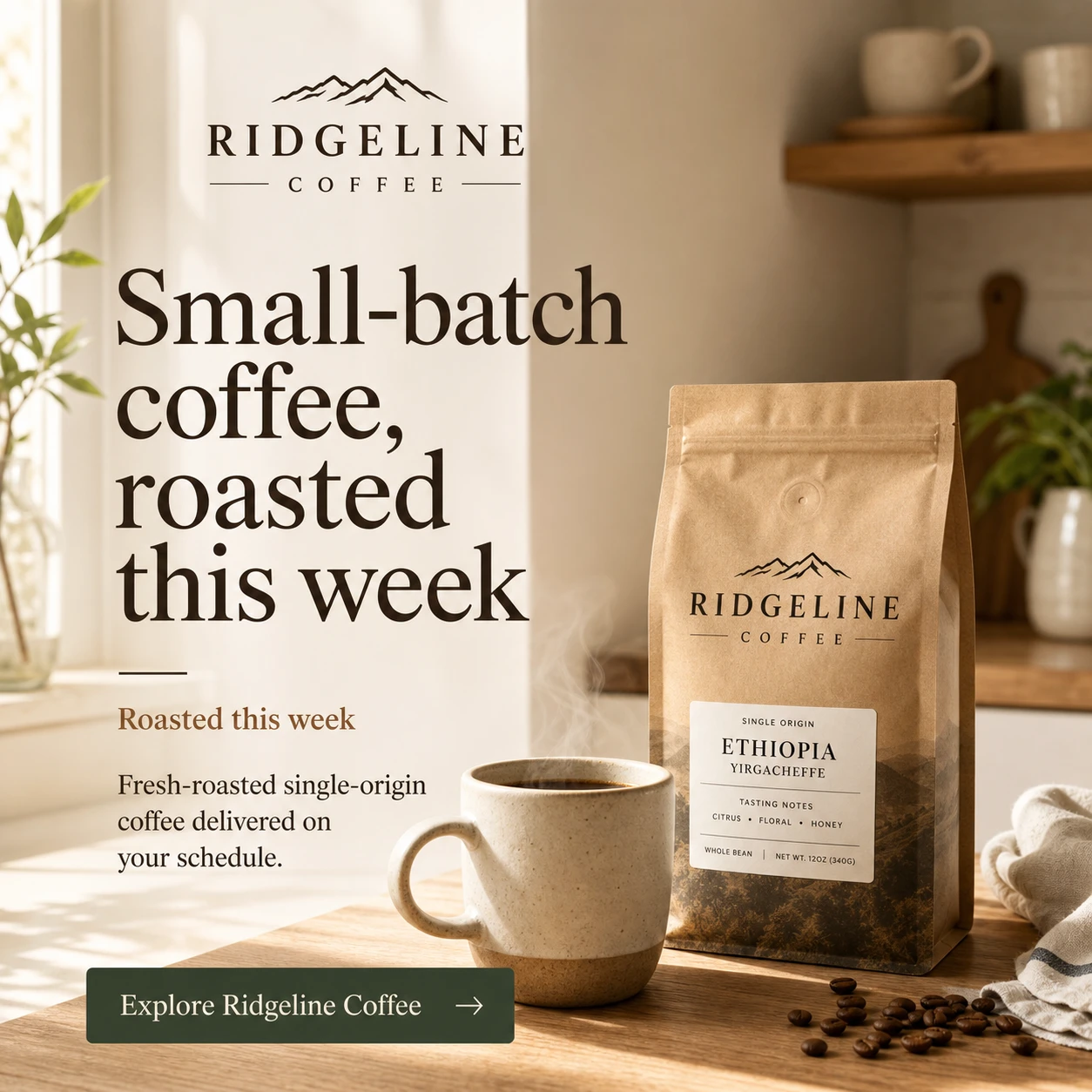
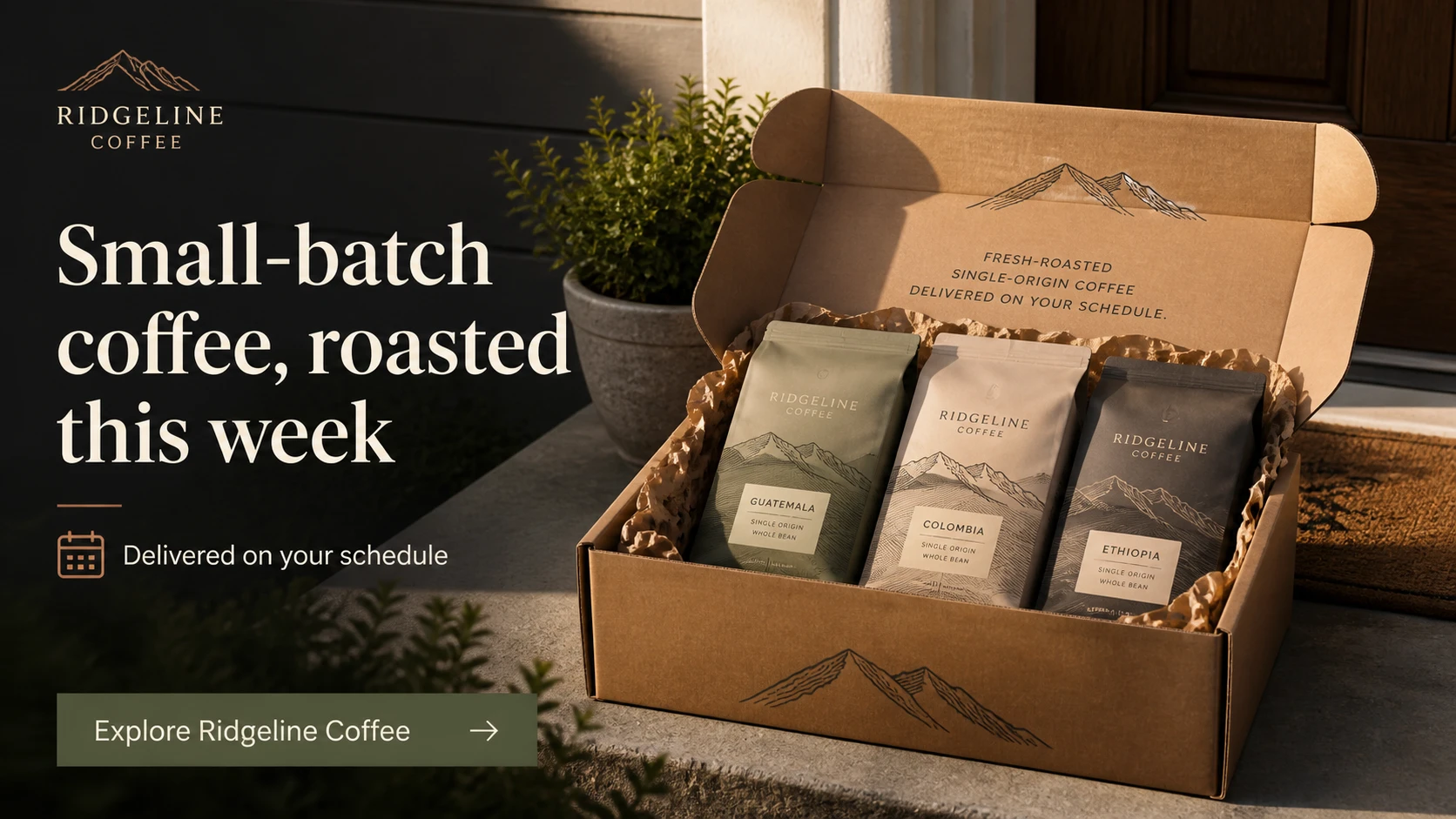
We stress-tested this with a fictional coffee subscription — Ridgeline Coffee, a small-batch roastery with one claim worth advertising: roasted this week:

One URL in. The AI read the palette, wrote the headline, and the full set — square, portrait, story, landscape, wide — came out coordinated, because they all came from the same read. No brief existed. No brand book existed. The website was the brief.

That second image is the one worth staring at, because it's the thing the high-friction path can't give you cheaply: an ad showing the product's actual mechanism — the signup flow — composed for the format, on-brand, from nothing but a URL.
The honest division of labor
None of this removes the founder from the process, and it shouldn't. The machine reads the brand, drafts the message, and generates the sizes. You still make the three calls that are actually yours: which product leads, which promise to test, which platform gets the budget first. That's the trade worth making — the mechanical 80% automated, the strategic 20% left where the judgment lives.
The industry spent two years making image generation fast and left the hard part — brand context — as homework. The brands that win the next stretch won't be the ones with the best AI images. They'll be the ones whose ads stopped looking like everyone else's homework.
More Posts
The agent harness race proves it: the model isn't the moat, the context is
DeepSeek Harness, Claude Code, OpenAI Codex — the 2026 agent wars look like a fight over models, but the winners are being decided one layer down, by who controls the context the model sees. Marketing AI works the same way.
Stop Prompting Your AI Ad Generator. Give It Your Website.
Most AI ad generators start with a prompt and end with a pretty image. I think that is the wrong starting point. Here is why a website makes a better brief, where the approach fails, and what I would actually ship.
I put this week's hottest AI agent tools on my actual marketing busywork — here's what survived
DeepSeek Harness is the internet's favorite repo this week. Can a coding-agent harness — dsh, Claude Code — actually help a solo founder's marketing? A no-hype test across the tasks that eat my week: resizing, ad copy, campaign briefs, landing checks.
Newsletter
Join the community
Subscribe to our newsletter for the latest news and updates